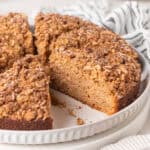
Applesauce Crumb Cake
This Applesauce Crumb Cake is soft, moist, and warmly spiced. With its super light crumb and crunchy streusel topping, it is the perfect cozy bake for dessert, morning coffee or afternoon tea!
Servings: 10
Calories: 341kcal
Ingredients
Crumb Topping
- 50 gr Unsalted Butter melted
- 50 gr Plain / All-Purpose Flour
- 50 gr Rolled Oats
- 50 gr Brown Sugar
- 1 teaspoon Ground Cinnamon
Applesauce Cake
- 225 gr Plain / All-Purpose Flour
- 1 1/2 teaspoon Baking Powder
- 1 pinch Fine Table Salt
- 1 teaspoon Ground Cinnamon
- 1/4 teaspoon Ground Clove
- 1/4 teaspoon Ground Nutmeg
- 120 gr Unsalted Butter soft, at room temperature
- 120 gr Light Brown Sugar
- 2 large Eggs at room temperature
- 240 gr Applesauce unsweetened
Instructions
Crumb Topping
- Melt the butter in a small saucepan over the stove or in the microwave. Set aside to cool.
- In a medium bowl, mix the flour, rolled oats, brown sugar and cinnamon until all ingredients are evenly distributed.
- Pour the melted butter over the dry mix. Using a heat-proof spatula, gently mix to cover all the dry ingredients with the melted butter. With your fingers, press the batter between your fingers to form small crumbs (see note 1).
- Place in the fridge to set while you prepare the cake.
Applesauce Cake
- Preheat your oven on 180 degrees Celsius / 350 degrees Fahrenheit. Line the bottom of a 22 cm / 8.5-inch Springform Pan with baking paper and set aside.
- In a small bowl, mix the flour, baking powder, salt and cinnamon, cloves and nutmeg. Set aside.
- In a large separate bowl (or bowl of your stand mixer fitted with the paddle attachment) use a hand mixer on medium speed to cream the butter and sugar for about 3 to 5 minutes. The mixture should look like a fluffy, thick paste.
- Add the eggs one at a time, mixing on medium low speed until fully combined (see note 2).
- Whisk in the applesauce, then add the dry ingredients mix. Mix on the lower speed and stop as soon as you cannot see streaks of flour. You should get a thick mixture.
Assembling the cake
- Pour the batter into the prepared springform pan. Use a small offset spatula or back of a spoon so smooth out the top and get an even layer.
- Sprinkle the oat crumble all over the cake batter. Break down larger chunks that might have solidified in the fridge to get pea size crumbs.
- Bake for about 35 minutes or until the cake has risen, the crumbs look golden and the tip of a knife or skewer comes out clean (see note 3).
- Place on a wire rack to cool down completely before removing from the pan. Optionally, dust with icing sugar before serving.Serve warm or cold.
Notes
- Be careful when using your fingers as the melted butter might still be warm.
- It is important for the butter to be at room temperature (between 18-20 degrees C / 65-68 degrees F) when creaming it with the sugar. If too cold (you can't easily dent it when pressed with a finger) or too warm (looks slightly greasy), the mixture will split once you add the eggs. If this happens, try to mix the mixture on high speed to push the emulsion (if butter is too cold) or place in the fridge for a few minutes (if butter is too warm).
- It can be hard to tell if the cake is ready because of the crumb topping. When unbaked, the centre of the cake will jiggle slightly when the pan is moved. Test the doneness with a toothpick or skewer to be sure it is fully baked.
Nutrition
Calories: 341kcal | Carbohydrates: 46g | Protein: 5g | Fat: 15g | Saturated Fat: 9g | Polyunsaturated Fat: 1g | Monounsaturated Fat: 4g | Trans Fat: 1g | Cholesterol: 74mg | Sodium: 90mg | Potassium: 111mg | Fiber: 2g | Sugar: 19g | Vitamin A: 487IU | Vitamin C: 0.3mg | Calcium: 72mg | Iron: 2mg